5 Signs Your Current Bakery Supplier Is Costing You Customers
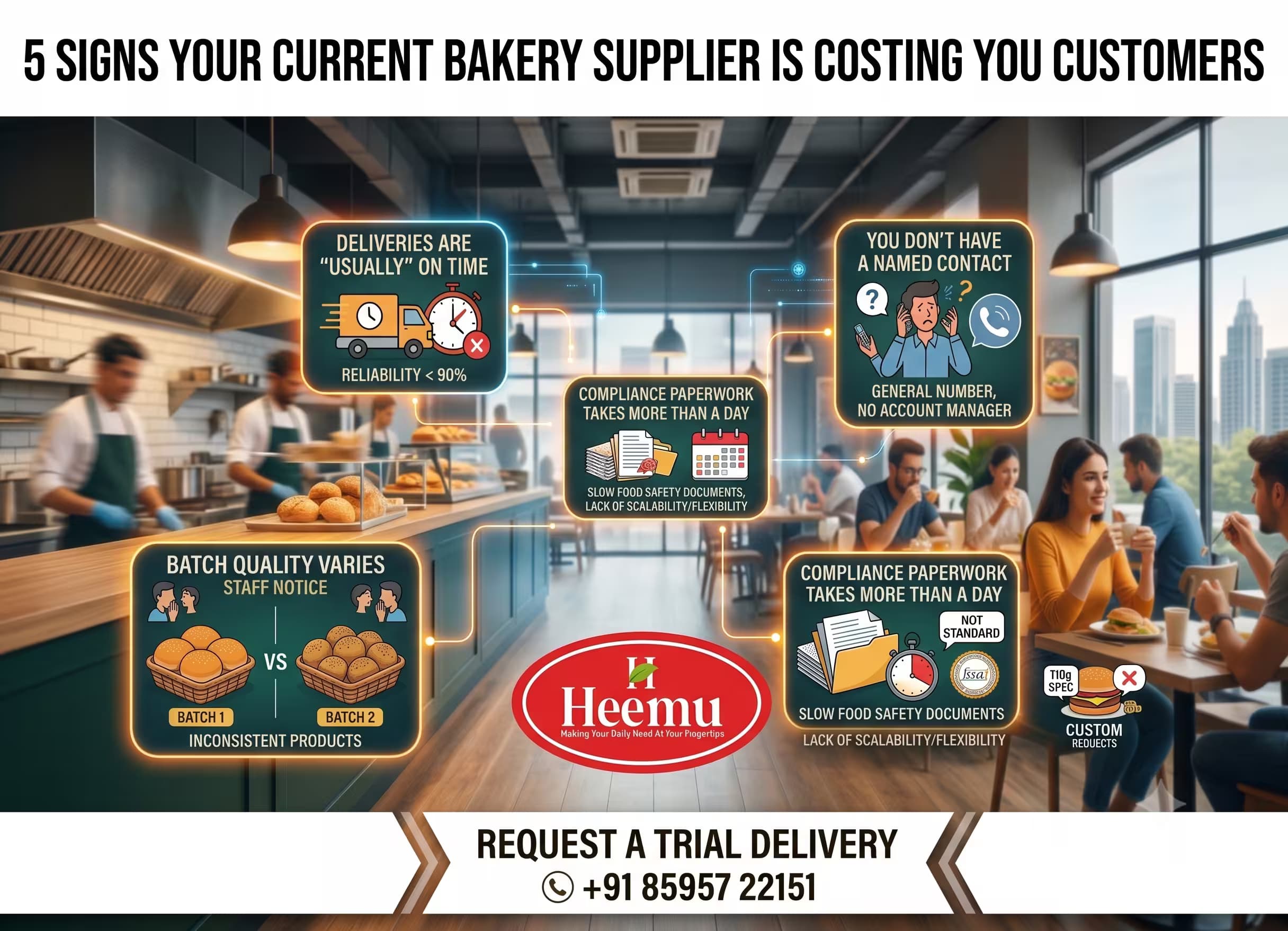
Your current bakery supplier could be costing you customers without a single missed delivery ever showing up on an invoice. Most restaurants, cafés and cloud kitchens don't switch bakery suppliers proactively — they switch after something visibly goes wrong, usually during a busy service, when there's no time left to compare alternatives calmly. But by the time a missed delivery forces the issue, the relationship has likely been quietly costing you covers, repeat guests and online reviews for months beforehand. Here are five signs worth taking seriously well before they turn into a Saturday-morning crisis, along with what each one actually means for your kitchen and what to check before your next contract renewal.
1. Deliveries Are "Usually" on Time
If your kitchen team describes deliveries as "usually" on time, that word is doing a lot of work. A supplier who's reliable 90% of the time is unreliable 10% of the time — and that 10% has a habit of landing on your busiest days, because that's when supply chains are under the most strain. Track it properly for a month: how many deliveries were late or short, and on which days. If you don't already have this data, the absence of it is itself a signal that delivery reliability isn't being managed as a metric.
2. Batch Quality Varies Enough That Staff Notice
When kitchen staff start commenting that "the buns were smaller this week" or "the loaves seem drier than usual," that's not a one-off — it usually means the supplier's production isn't standardised enough to guarantee batch-to-batch consistency. This tends to trace back to non-calibrated equipment, recipes that aren't strictly measured, or the absence of a real QC check between batches. Guests notice inconsistency even when they can't name it; it shows up as "the food felt off" in reviews rather than a specific complaint about bread. Our post on fresh vs frozen bread covers one common root cause of this kind of drift.
3. You Don't Have a Named Contact
If getting a change made — a volume adjustment, a recipe tweak, an urgent top-up order — means calling a general number and re-explaining your account each time, that's a structural weakness in the relationship, not a minor inconvenience. It means every issue takes longer to resolve than it should, and small requests that a dedicated account manager would handle in one message become multi-call negotiations.
4. Compliance Paperwork Takes More Than a Day to Produce
Any legitimate B2B bakery supplier should be able to produce their current license from the Food Safety and Standards Authority of India (FSSAI) and relevant food-safety documentation on request, promptly. If a compliance or audit request turns into a multi-week back-and-forth, it's worth asking whether that reflects how seriously food safety is handled operationally, not just administratively.
5. Custom Requests Get Treated as Favours, Not Standard Service
A burger bun at a specific gram weight, a loaf sliced to a specific thickness, an eggless variant for a menu line — these are common, reasonable B2B requests, and a supplier with a broad enough product range should be able to accommodate most of them as standard B2B account management. If your current supplier treats every custom spec as an exception requiring special approval and extra cost, it's a sign the relationship hasn't scaled with your business.
Supplier Health-Check Checklist
Use this as a quarterly scorecard rather than waiting for a crisis to prompt the review:
| Sign | What to Track | Action If It's Failing |
|---|---|---|
| Delivery reliability | Missed or late deliveries per month, by day of week | Ask for a documented delivery record; compare against contract terms |
| Batch consistency | Staff comments on size, texture or taste variance | Request the supplier's QC process; run a side-by-side batch comparison |
| Account support | Time to resolve a routine request (recipe tweak, volume change) | Ask for a named account manager, not a general support line |
| Compliance documentation | Time to produce FSSAI/ISO paperwork on request | Request all current documentation now, before an audit forces the issue |
| Custom-spec flexibility | Whether custom requests incur extra cost or delay | Get custom-spec terms in writing as part of the account agreement |
How to Switch Suppliers Without Disrupting Service
Recognising the signs is only half the job — switching without a rocky transition takes a bit of sequencing:
- Run a trial delivery on a quiet day first, not your busiest service, so any issues surface without guest-facing consequences.
- Overlap both suppliers for one to two weeks rather than cutting over all at once, so you have a fallback if the new supplier's first live week has teething problems.
- Get custom specs and pricing in writing before full cutover — verbal agreements from the sales conversation tend to drift once the account is live.
- Check your existing contract's notice period so the transition doesn't create an overlap cost or a supply gap between the old and new supplier.
If any of the checklist items above are already ringing a bell, our guide to choosing a bulk bread supplier in Gurgaon covers exactly what to look for in whoever you switch to.
Conclusion
None of these five signs show up as a line item on an invoice. They show up as an occasional bad Saturday, a guest review mentioning "off" bread without specifics, a kitchen manager quietly working around a supplier rather than raising it. By the time the cost is visible in the numbers, it's usually been accumulating for a while — which is exactly why a scheduled quarterly check against the criteria above is worth more than waiting for the next missed delivery to force the conversation.
If any of these sound familiar, it's worth getting a trial delivery from an alternative supplier before your next contract renewal, rather than after the next missed delivery. JBR International supplies 100+ restaurants, hotels and cloud kitchens across Gurugram and Delhi-NCR with a documented zero-missed-delivery record, one dedicated account manager per client, and FSSAI/ISO-compliant production — request a trial delivery to compare.
Frequently Asked Questions
What are the warning signs of a bad bakery supplier?
The five clearest warning signs are: deliveries that are only "usually" on time rather than reliably tracked, batch quality that varies enough for kitchen staff to notice, no named account contact, compliance paperwork that takes more than a day to produce, and custom requests treated as favours instead of standard service.
How do I know if my bakery supplier is affecting my reviews?
Look for guest reviews mentioning food that felt "off" or inconsistent without a specific complaint about bread — that vague dissatisfaction is often a batch-consistency issue traced back to the supplier rather than the kitchen. Cross-reference review dates against your delivery log for patterns on specific days.
Is it disruptive to switch bakery suppliers?
Not if it's staged properly. Run a trial delivery, then a short overlap period with both suppliers active before fully cutting over, and time the switch outside your highest-volume week. Most restaurants and hotels complete a full switch within two to four weeks with no service disruption.
How often should I review my bakery supplier relationship?
A basic reliability and consistency review every quarter is reasonable for most B2B kitchens, with a fuller review — covering compliance documentation, pricing and custom-spec flexibility — at each contract renewal, typically annually.

About the Author
Birbal Singh · Founder
Birbal founded JBR International Ventures Private Limited with a vision to bring world-class bakery solutions to India, and holds a post-graduate degree in International Business.